South Dakota Dog Registration Information
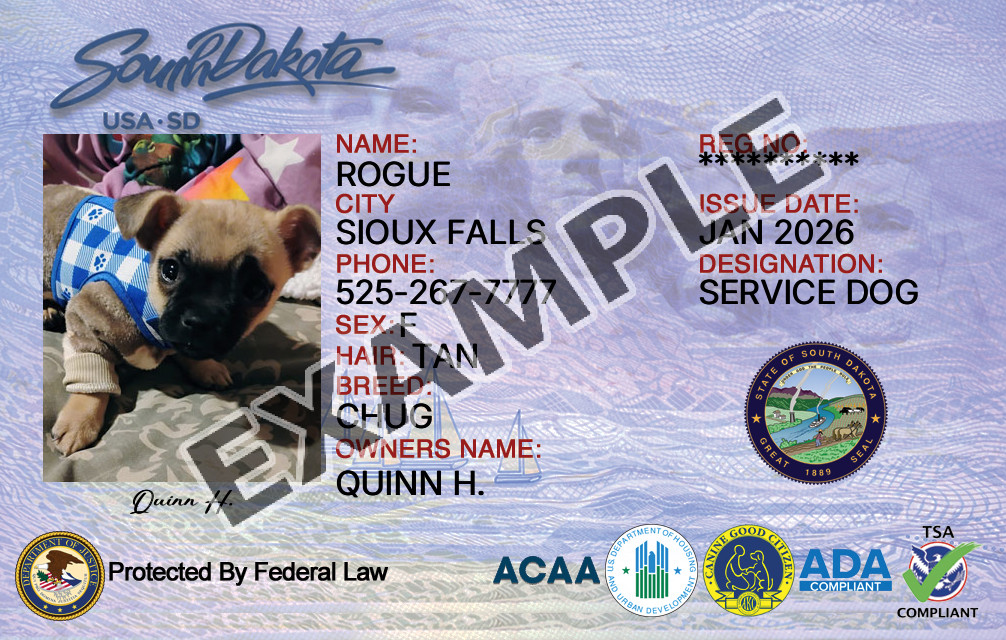
State Licensed, Service Dogs and Emotional Support Dogs in South Dakota
If you are searching for how to register my dog in South Dakota, the most important thing to know is that dog licensing is usually handled locally. South Dakota law gives municipalities the power to regulate dogs and impose a dog license, and counties also have authority to impose a county dog license or tax in areas not already covered by a municipal ordinance. In practice, this means a dog license in South Dakota is often handled by a city animal control office, a police or community service unit, a city treasurer, or another local government office depending on where your dog lives.
That local structure is why people often search for where to register a dog in South Dakota and get different answers depending on the city or county. Some places require licensing through animal control. Others issue tags through city hall or the city treasurer. Rabies vaccination is also closely tied to local licensing rules. Even though South Dakota does not have one single statewide pet registration portal, cities and counties across the state use official local offices to handle pet licensing, animal control, and rabies-related enforcement.
Where to Register or License Your Dog in South Dakota
Because licensing is often handled at the county or city level, the offices below are examples of official South Dakota government offices connected to dog licensing, animal control, or rabies enforcement. Your correct office depends on your local jurisdiction.
Sioux Falls Law Enforcement Center
320 W. 4th Street
Sioux Falls, SD 57104
Phone: 605-367-7226
Email: Not publicly listed in plain text on the official pages reviewed
Office Hours: Monday through Friday 8:00 am to 5:00 pm
City of Aberdeen Treasurer's Office
123 S. Lincoln Street
Aberdeen, SD 57401
Phone: 605-626-7026
Email: Not publicly listed in plain text on the pet information page reviewed
Office Hours: Not clearly listed on the pet licensing page reviewed
Brookings Animal Control and Community Service
307 Third Ave.
Brookings, SD 57006
Phone: 605-692-2113
Email: Not publicly listed in plain text on the facility page reviewed
Office Hours: Not clearly listed on the official animal control page reviewed
Hartford City Hall
125 N Main Avenue
Hartford, SD 57033
Phone: 605-528-6187
Email: Not publicly listed in plain text on the licensing page reviewed
Office Hours: Monday through Thursday 7:30 am to 5:30 pm; Friday 8:00 am to 12:00 pm
City of Pierre
2301 Patron Parkway
Pierre, SD 57501
Phone: 605-773-7407
Email: Not publicly listed in plain text on the contact page reviewed
Office Hours: Not clearly listed on the contact page reviewed
Overview of Dog Licensing in South Dakota
Dog licensing in South Dakota is mostly local
South Dakota does not use one single statewide office where every resident goes to register a dog. Instead, dog licensing is mainly a local responsibility. Municipal governments have authority to regulate dogs and impose dog licenses, and counties may also regulate dogs and impose a license or tax in some areas. This local system explains why the answer to where to register a dog in South Dakota depends on the city or county where you live.
Common offices that handle licensing
Depending on the community, the actual licensing office may be a city treasurer, animal control office, police community service unit, or another local government department. In Sioux Falls, pet licenses are tied to the city animal control program and may be purchased through the Law Enforcement Center, veterinarians in the city, and other designated locations. In Aberdeen, the City Treasurer's Office handles pet licenses. In Brookings, official animal control resources point residents toward animal control for pet licensing. This variety is normal in South Dakota because licensing is built around local government structure rather than a statewide registration portal.
When dogs usually need to be licensed
Many South Dakota city ordinances require dogs six months of age or older to be licensed. Sioux Falls requires licensing for dogs and cats older than six months. Aberdeen also requires city dogs and cats over six months to be licensed. Other cities may use similar local rules, but owners should always verify the exact age threshold in their own jurisdiction. Since local rules control the details, it is best not to assume another city's age rule applies to your own address.
Why licensing matters
A dog license in South Dakota is more than just a tag. Licensing helps local government identify owned pets, return lost animals to their owners more quickly, and support animal control services. It can also help show that the dog has current rabies compliance when local ordinances require proof before a license is issued. If your dog is found running at large, the tag can make a major difference in how quickly officers or shelter staff identify you.
How Dog Licensing Works Locally in South Dakota
Local rules control the process
The most important thing about how to register my dog in South Dakota is that the exact process depends on local law. State law gives counties and municipalities the authority to regulate dogs and impose licenses, but each local government decides how that authority is used in practice. Some cities require annual licenses that expire at the end of the year. Others tie the expiration date to the rabies certificate. Some offices let owners buy a tag at city hall. Others direct owners to animal control or a participating veterinarian.
A typical step by step process
- Confirm that your dog is old enough for licensing under your local ordinance.
- Make sure your dog has a current rabies vaccination certificate if your local office requires it.
- Find the city or county office that serves your home address.
- Complete the local application or licensing process.
- Provide any required supporting records, including proof of rabies vaccination and sometimes proof of spay or neuter status.
- Pay the fee.
- Receive the tag and keep it attached as required by local rules.
Rabies vaccination requirements
South Dakota handles rabies in a way that combines state public health guidance with local enforcement. The South Dakota Department of Health encourages pet vaccination as a major rabies prevention step, and local licensing programs commonly require proof of current rabies vaccination before they issue a dog license. For example, Sioux Falls requires dogs and cats older than six months to be licensed and vaccinated for rabies. Aberdeen also requires proof of current rabies vaccination when applying for a city pet license. In addition, South Dakota import rules require certification of a current rabies vaccination for dogs or cats over three months of age brought into the state. This means rabies vaccination is one of the most important documents owners should have ready.
Animal control and rabies enforcement
Animal control offices and local enforcement programs often do much more than issue tags. They may respond to loose animals, investigate complaints, handle bites, coordinate quarantine or observation issues, and support public safety. South Dakota rabies control law also addresses confinement rules for pets exposed to suspected rabies. This is why people searching for animal control dog license South Dakota often end up dealing with both licensing staff and animal control officers. The licensing office handles the registration, while animal control may handle enforcement when a problem happens.
Why local variation matters
One South Dakota city may have licensing through a police records counter, another through city hall, and another through a community service officer. Fees may also vary, especially if altered and unaltered pets are treated differently. Renewal periods can vary as well. This local variation is normal, so owners should always rely on the official office for their own community rather than a general statewide assumption.
Service Dog Laws in South Dakota
A dog license is not service dog legal status
One of the most common misunderstandings is the idea that a pet license somehow creates service dog rights. It does not. A South Dakota dog license is a local government requirement tied to animal ownership, identification, and often rabies compliance. Service dog legal status comes from disability law and the dog's training to perform work or tasks for a person with a disability. A city tag or county dog license is not proof that a dog is legally a service animal.
What legally makes a dog a service dog
Under federal disability law, a service animal is generally a dog that has been individually trained to do work or perform tasks directly related to a person's disability. The legal focus is on the dog's training and the handler's disability-related need. This is entirely different from a pet licensing system. Local governments license dogs to regulate pet ownership and protect public health. They do not decide service dog status through an ordinary licensing application.
Local compliance may still apply
Even a legitimate service dog may still need to comply with general rules that apply to dogs in the community, including rabies requirements and local licensing rules where applicable. Service dog law and pet licensing answer different questions. One deals with disability access rights. The other deals with local animal regulation.
Emotional Support Animal Rules in South Dakota
Emotional support animals are different from dog licenses
An emotional support animal is not the same as a local dog license. If your animal is a dog and your South Dakota city or county requires licensing, you generally still need a dog license in South Dakota even if the dog provides emotional support. Local licensing is about ordinary ownership and public health requirements. ESA status usually becomes relevant in housing or accommodation settings instead.
Emotional support animals are also different from service dogs
Emotional support animals do not have the same public access rights as trained service dogs. A service dog is defined by disability-related task training. An emotional support animal may provide comfort or therapeutic benefit, but that does not automatically create the same access rights in public places. This distinction matters because many pet owners assume that any assistance-related paperwork changes local licensing duties. In most cases, it does not.
Housing issues are separate from licensing
Housing providers may have to consider disability-related accommodation requests involving assistance animals, including emotional support animals, under fair housing rules. That is separate from registering your dog with your local South Dakota office. So if your main question is where to register a dog in South Dakota, the answer is still your city or county licensing authority, not a private registry or landlord letter.
Frequently Asked Questions
Do I register my dog with the State of South Dakota?
No. In most cases, licensing is handled by local city or county government, not one statewide pet registration office.
What office should I contact first?
Start with your city hall, city treasurer, animal control office, police community service unit, or county office that serves your address.
Do I need rabies vaccination proof?
In many South Dakota communities, yes. Local programs commonly require proof of current rabies vaccination before issuing a license.
At what age does my dog need a license?
Many local ordinances use six months of age, but you should verify your own city or county rule.
Is a dog license the same as service dog registration?
No. A dog license is a local pet licensing requirement. Service dog status depends on disability law and task training.
Does an emotional support animal still need a dog license?
Usually yes, if the animal is a dog and the local community requires licensing.
Why do some places use city hall and others use animal control?
Because South Dakota licensing is local. Different communities assign dog licensing duties to different official offices.
What happens if I move?
If you move to another South Dakota city or county, your licensing authority may change. You should check the rules in your new jurisdiction as soon as possible.
What You May Need
- rabies vaccination proof
- identification
- proof of residency
- licensing fee
Quick South Dakota Licensing Notes
Most licensing is handled locally.
City hall, animal control, or a treasurer may issue the tag.
Rabies proof is commonly required.
Age rules and renewal periods can vary by community.
Disclaimer
Licensing requirements and office locations may change. Residents should verify details with their local animal services office within South Dakota.
Register A Dog In Other South Dakota Counties
Select your county from the dropdown below to get started with your dog’s ID card. Requirements and license designs may vary by county, so choose your location to see the correct options and complete your pup’s registration.
- Aurora Dog License Cards
- Beadle Dog License Cards
- Bennett Dog License Cards
- Bon Homme Dog License Cards
- Brookings Dog License Cards
- Brown Dog License Cards
- Brule Dog License Cards
- Buffalo Dog License Cards
- Butte Dog License Cards
- Campbell Dog License Cards
- Charles Mix Dog License Cards
- Clark Dog License Cards
- Clay Dog License Cards
- Codington Dog License Cards
- Corson Dog License Cards
- Custer Dog License Cards
- Davison Dog License Cards
- Day Dog License Cards
- Deuel Dog License Cards
- Dewey Dog License Cards
- Douglas Dog License Cards
- Edmunds Dog License Cards
- Fall River Dog License Cards
- Faulk Dog License Cards
- Grant Dog License Cards
- Gregory Dog License Cards
- Haakon Dog License Cards
- Hamlin Dog License Cards
- Hand Dog License Cards
- Hanson Dog License Cards
- Harding Dog License Cards
- Hughes Dog License Cards
- Hutchinson Dog License Cards
- Hyde Dog License Cards
- Jackson Dog License Cards
- Jerauld Dog License Cards
- Jones Dog License Cards
- Kingsbury Dog License Cards
- Lake Dog License Cards
- Lawrence Dog License Cards
- Lincoln Dog License Cards
- Lyman Dog License Cards
- Marshall Dog License Cards
- McCook Dog License Cards
- McPherson Dog License Cards
- Meade Dog License Cards
- Mellette Dog License Cards
- Miner Dog License Cards
- Minnehaha Dog License Cards
- Moody Dog License Cards
- Oglala Lakota Dog License Cards
- Pennington Dog License Cards
- Perkins Dog License Cards
- Potter Dog License Cards
- Roberts Dog License Cards
- Sanborn Dog License Cards
- Spink Dog License Cards
- Stanley Dog License Cards
- Sully Dog License Cards
- Todd Dog License Cards
- Tripp Dog License Cards
- Turner Dog License Cards
- Union Dog License Cards
- Walworth Dog License Cards
- Yankton Dog License Cards
- Ziebach Dog License Cards
